
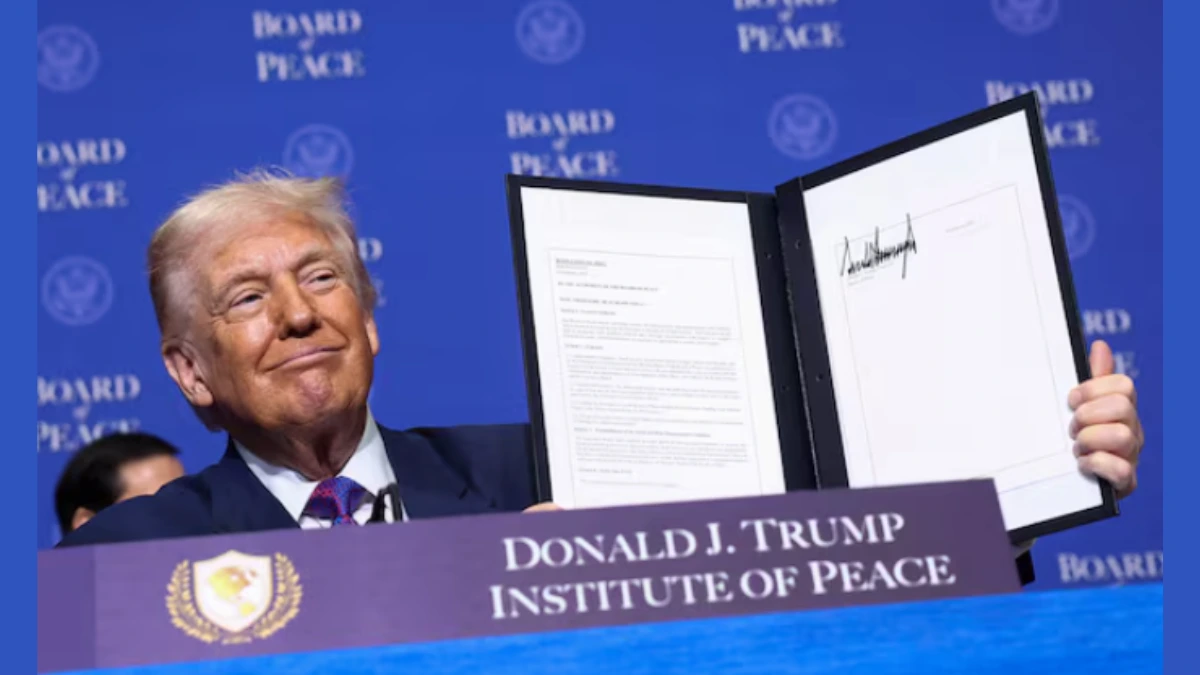
U.S. President Donald Trump’s “Board of Peace” has emerged as one of the most debated international initiatives of his presidency, drawing both support and criticism for its ambitious role in addressing conflicts in the Middle East, particularly in Gaza.
Originally proposed as part of Trump’s broader peace efforts, the Board of Peace is an international body designed to oversee disarmament initiatives, coordinate humanitarian and reconstruction efforts, and support political transitions in conflict-affected regions. The organization has been closely linked to plans aimed at bringing stability to Gaza following prolonged regional tensions. Its mandate has expanded beyond humanitarian assistance to include diplomatic and security-related responsibilities.
What Is the Board of Peace?
The Board of Peace was introduced by President Trump in late 2025 as a multinational initiative involving participating member countries. According to publicly available information, the organization is structured to bring together governments willing to contribute financially and politically to peacebuilding efforts. Member states can participate in reconstruction programs and other diplomatic initiatives coordinated by the board.
Trump has described the initiative as an alternative approach to traditional international peace mechanisms, arguing that it offers faster and more direct decision-making in conflict resolution. The board operates separately from established institutions while working alongside international partners where necessary.
Gaza Disarmament Agreement
The Board of Peace recently gained international attention after President Trump announced that it had helped secure an agreement aimed at the phased disarmament of militant groups in Gaza and the gradual withdrawal of Israeli military forces from the territory. The proposed framework also includes plans for international stabilization efforts and reconstruction programs.
Supporters of the initiative view it as a significant diplomatic breakthrough that could create conditions for long-term stability in the region. However, implementation remains dependent on cooperation among multiple parties and the successful execution of complex political and security arrangements.
International Participation and Criticism
More than two dozen countries have reportedly joined or supported aspects of the Board of Peace initiative. At the same time, several major nations have declined invitations to participate, raising questions about the organization’s legitimacy and global representation. Critics have expressed concerns regarding governance, decision-making authority, and the absence of broader international consensus.
Some analysts have also questioned whether the board’s structure could overlap with responsibilities traditionally carried out by international organizations involved in peacekeeping and conflict resolution. Others have pointed to concerns surrounding representation in discussions affecting Palestinian governance and reconstruction efforts.
To know more politics news