
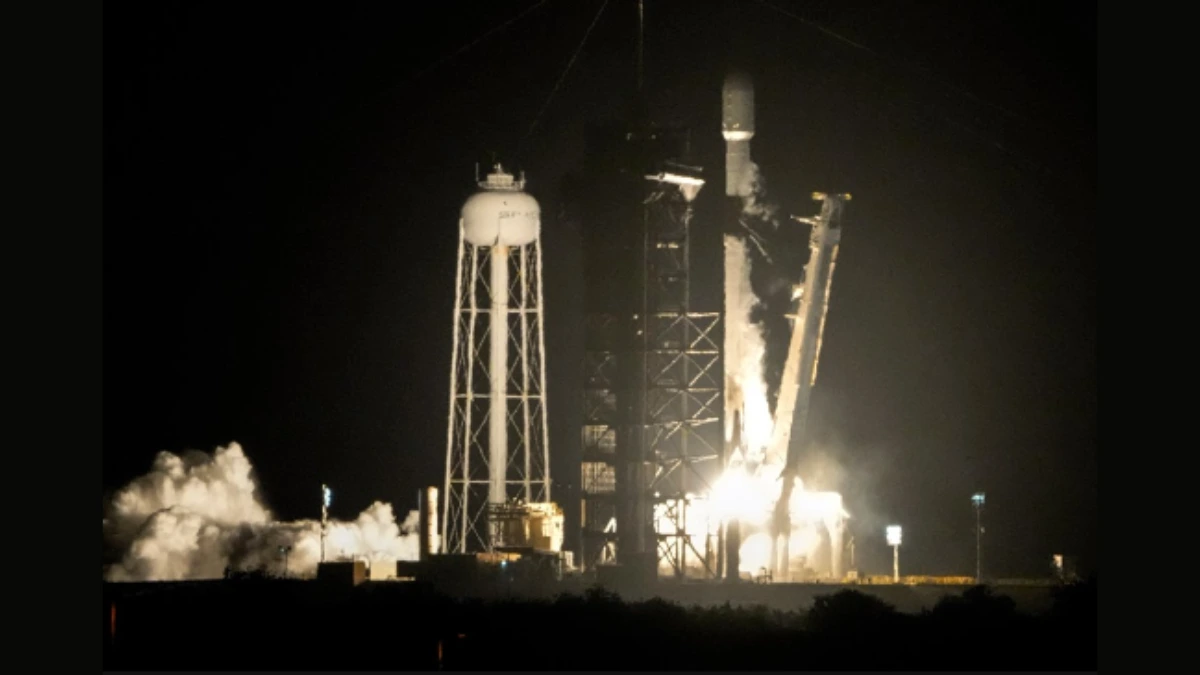
A discarded SpaceX rocket stage is hurtling toward the Moon and is expected to crash into its surface at thousands of miles per hour, marking a rare event that scientists say could provide new insights into lunar geology and the growing issue of space debris.
The rocket fragment, a Falcon 9 upper stage launched during a commercial lunar mission in early 2025, has been drifting through space after completing its mission. Without enough fuel to return to Earth or adjust its trajectory, the booster gradually fell under the influence of the Earth-Moon gravitational system and is now on a collision course with the Moon.
Experts estimate the object will strike the lunar surface at approximately 5,400 mph (8,700 km/h). The impact is expected to occur near the Moon’s far western region, where it will carve out a fresh crater and send a cloud of dust and rock high above the lunar surface.
Astronomers say the collision poses no threat to Earth or to astronauts currently in space. Instead, it offers a valuable scientific opportunity. Researchers plan to observe the impact using ground-based telescopes and lunar orbiters to study how craters form and how lunar material is ejected during high-speed impacts.
The event also shines a spotlight on the growing amount of human-made debris beyond Earth’s orbit. While most spent rocket stages are designed to burn up in Earth’s atmosphere or are deliberately redirected, some deep-space missions leave hardware in long-term solar or lunar orbit, where gravitational forces can eventually send them toward planetary bodies.
Scientists believe the impact could help improve computer models used to understand asteroid strikes and the evolution of the Moon’s surface. Observations of the newly formed crater may also provide clues about the composition of subsurface lunar material.
The incident comes as interest in lunar exploration continues to grow, with government agencies and private companies planning an increasing number of missions to the Moon over the coming decade. Experts say the unexpected collision underscores the importance of developing long-term strategies for disposing of spacecraft and rocket components after their missions end.
Although spacecraft have intentionally crashed into the Moon during previous scientific missions, accidental impacts involving discarded rocket stages remain relatively uncommon. Because the trajectory of this object has been tracked well in advance, astronomers around the world are preparing to monitor the collision and analyze its aftermath.
As humanity’s presence in deep space expands, researchers say the event serves as a reminder that responsible management of space hardware will play an increasingly important role in protecting future lunar missions and preserving the space environment.
To know more Bussines&Finnance news