
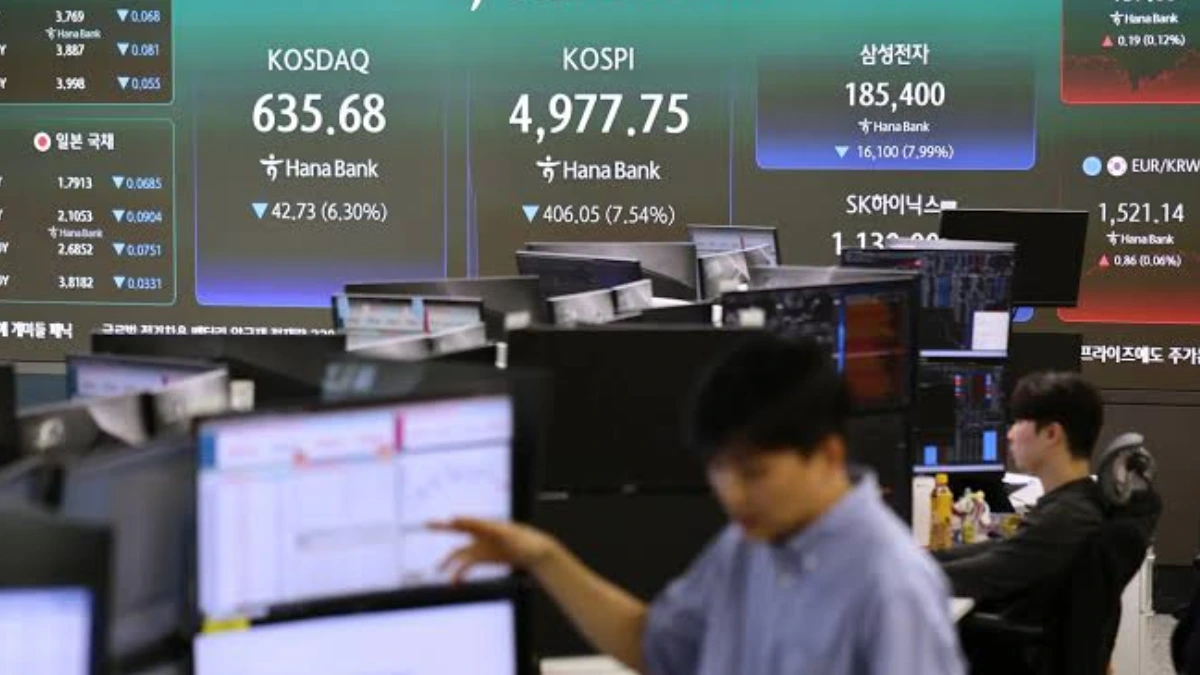
kospi index Asian stock markets came under renewed pressure on Monday as investors grew increasingly concerned about the sustainability of the artificial intelligence boom. Sharp declines in South Korea, Taiwan and Hong Kong reflected growing uncertainty over technology company valuations, massive AI investments and the possibility of a market correction.
South Korean Stocks Lead Regional Declines
South Korea’s benchmark Korea Composite Stock Price Index (Kospi) experienced significant losses during early trading on November 23, falling as much as 4.3 percent. The decline extended the technology-led sell-off that had affected major markets across Asia and the United States during the previous trading session.
Taiwan’s Taiex and Hong Kong’s Hang Seng Index also declined by more than 1 percent as investors reduced exposure to technology-related stocks. Japan’s financial markets remained closed for Labour Thanksgiving Day.
The latest downturn followed a difficult Friday trading session. South Korea’s Kospi dropped 5.2 percent, Japan’s Nikkei 225 declined 5.1 percent, and Taiwan’s Taiex lost 6.2 percent. Hong Kong’s Hang Seng Index also finished lower, adding to concerns about the broader regional outlook.
Growing Concerns Over AI Investment kospi index
Investors are increasingly questioning whether technology companies can generate sufficient profits to justify the enormous amounts of money being invested in artificial intelligence infrastructure.
Major technology companies have committed trillions of dollars to building data centres, developing advanced computer chips and expanding the computing capacity required to operate increasingly sophisticated AI systems. However, concerns are emerging about whether future revenues will be strong enough to support these investments.
According to estimates from technology research company Gartner cited by Al Jazeera, global AI-related investment is expected to reach $2.7 trillion in 2026 and $3.6 trillion in 2027.
Much of this spending is supported by debt, raising additional questions about financial risks if the expected returns fail to materialise. Investors are also becoming more cautious about technology companies whose share prices have increased rapidly on expectations of future AI growth.
Wall Street Losses Add to Global Market Pressure kospi index
The weakness across Asian markets followed another difficult week on Wall Street. On Friday, the S&P 500 declined 3.7 percent, marking its seventh consecutive session of losses. The technology-focused Nasdaq Composite dropped 5.3 percent, erasing its gains for the year.
The sell-off highlighted how closely connected global markets have become through technology investments and semiconductor supply chains.
Companies such as Samsung Electronics, SK Hynix and Taiwan Semiconductor Manufacturing Company play important roles in the global AI industry. Their performance is closely linked to demand for advanced chips and computing infrastructure.
As investors reconsider the outlook for artificial intelligence spending, semiconductor-related companies have faced increasing pressure.
Regulatory Uncertainty Adds to Investor Anxiety
Beyond concerns about company valuations, political and regulatory developments are also influencing investor sentiment.
Growing calls for stronger oversight of the AI industry, potential restrictions on advanced semiconductor exports to China and uncertainty surrounding future data-centre construction have added to market volatility.
The political environment in the United States could also influence the future direction of the technology sector, particularly as policymakers consider the economic, security and environmental implications of expanding AI infrastructure.
These developments have encouraged some investors to reconsider their exposure to high-growth technology stocks.
What Happens Next for Asian Markets?
The latest market declines raise important questions about the future of the AI investment boom and its influence on global financial markets.
South Korea’s government has indicated that it is prepared to activate market stabilisation funds if conditions deteriorate further. Taiwan and China have also taken steps aimed at supporting financial market stability.
Although artificial intelligence remains an important long-term technology opportunity, investors are becoming more selective about which companies can turn AI-related spending into sustainable profits.
For Asian markets, the coming trading sessions could prove important in determining whether the current decline represents a temporary correction or the beginning of a broader reassessment of technology valuations.
The immediate challenge for investors is balancing confidence in AI’s long-term potential against the financial risks associated with rapidly expanding investment and increasingly expensive technology stocks.