
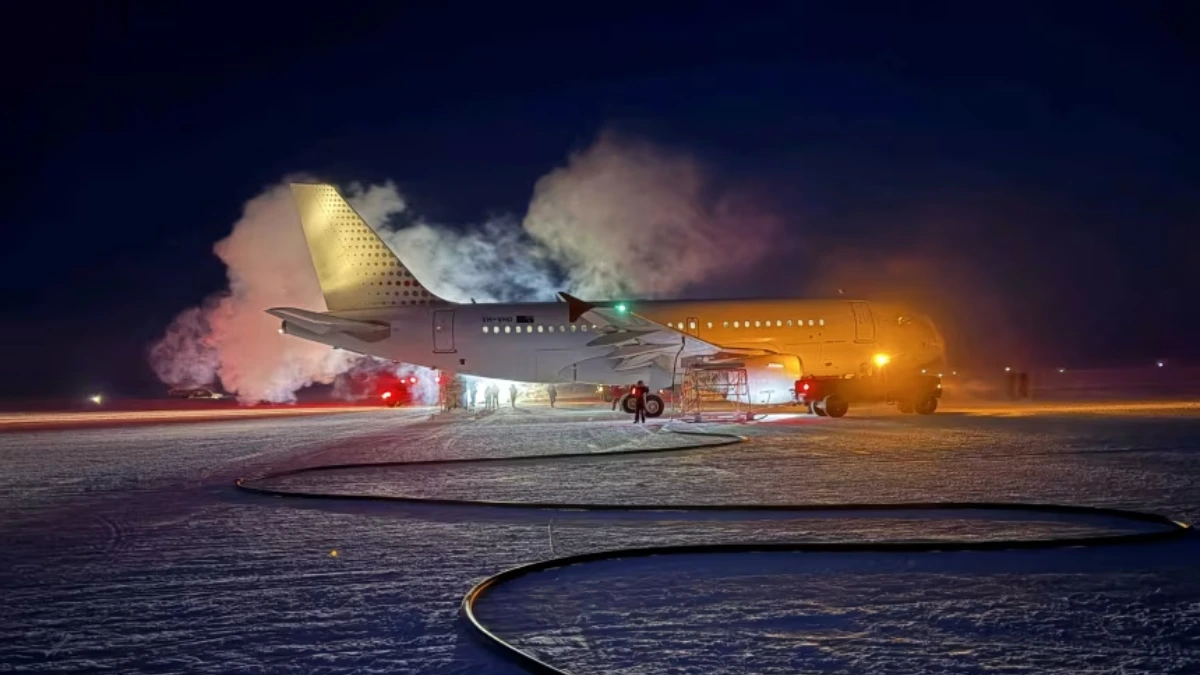
In the darkness of the Antarctic winter, an Australian aviation crew undertook an extraordinary medevac mission to evacuate a seriously ill American from one of the most remote research stations on Earth.
On July 31, a Skytraders Airbus A319 Long Range, known as Snowbird 1, flew from Hobart, Australia, to the U.S. McMurdo Station after receiving an urgent request for medical assistance. The flight took place in conditions that make Antarctic aviation particularly dangerous: temperatures fell to about minus 43 degrees Celsius, while the airfield was surrounded by near-total darkness.
The patient was eventually flown from Antarctica to Christchurch, New Zealand, where the person was admitted to hospital in serious condition, according to the U.S. National Science Foundation.
A Mission Against the Antarctic Winter
Antarctica’s winter creates extraordinary obstacles for aircraft. From February through August, much of the continent experiences extremely limited sunlight, while temperatures can plunge to levels that make ordinary aviation operations impossible.
For the crew of Snowbird 1, the mission required careful coordination between pilots, medical personnel, meteorologists and ground crews.
The aircraft departed Hobart after waiting for suitable weather. The journey to McMurdo took about five and a half hours, with the crew facing temperatures of roughly minus 43 C when they arrived at Phoenix Airfield near the research station.
Skytraders said the conditions were close to the limits of the specialized aircraft’s capabilities.
Preparing the Aircraft for an Emergency
The urgency of the situation meant there was little time to prepare.
According to reporting on the mission, Snowbird 1 was rapidly converted into a medical evacuation aircraft, with the necessary medical equipment and personnel assembled within about 24 hours of the request.
The aircraft is well suited to remote operations. Skytraders’ A319 aircraft have long-range capabilities and can be configured to carry intensive-care stretchers for emergency evacuations. The company has provided Antarctic aviation services for decades and has experience conducting medical missions for several national Antarctic programs.
That experience was critical during the latest mission.
Landing in Complete Darkness
The most difficult part of the operation came as the aircraft approached McMurdo.
The crew had to land at an Antarctic airfield in darkness and extreme cold, knowing that weather conditions could deteriorate rapidly.
Pilot Al Wallach described the operation as exceptionally demanding, while co-pilot Louise Robertson highlighted the tension involved in attempting a mission in such conditions. The crew had to prepare for the possibility that they might not be able to land or could be forced to delay the operation because of changing weather.
Once on the ground, the medical team quickly transferred the patient.
The aircraft then departed Antarctica the same day, with deteriorating weather making the timing of the return flight particularly important. The patient was taken directly to Christchurch, where further medical treatment was available.
International Cooperation
The rescue was the result of cooperation between several organizations and countries.
The U.S. National Science Foundation and personnel at McMurdo coordinated with Australian and New Zealand partners. Skytraders operated the aircraft under its long-standing relationship with the Australian Antarctic Division, while New Zealand provided the destination for the patient’s hospital care.
The NSF expressed gratitude to the teams involved, emphasizing the importance of international partnerships in supporting people working in Antarctica.
Such cooperation is essential because no single country can easily maintain a complete emergency-response system in one of the world’s most isolated environments.
Not the First Antarctic Winter Rescue
Although midwinter evacuations are extremely rare, this was not Skytraders’ first experience with such a mission.
The company says it conducted an earlier winter medical evacuation from Antarctica for the U.S. Antarctic Program. In 2012, an Australian Antarctic Division team used a Skytraders A319 to evacuate an American expeditioner from McMurdo during the Antarctic winter.
A later evacuation in March 2020 also involved a Skytraders A319 flying from Hobart to McMurdo before transferring a U.S. expeditioner to Christchurch. That mission was conducted in late season, when Antarctic operations were already winding down.
The latest operation was notable because of its timing and the severity of the conditions.
A Race Against Time and Weather
For crews working in Antarctica, a medical emergency can quickly become a race against more than an illness.
Weather can close an airstrip, darkness can make flights impossible and extreme cold can create additional risks for aircraft and people on the ground. A delay of even a short period can make an already dangerous situation significantly more complicated.
That was why the July 31 mission required precise planning and a narrow window of opportunity.
The successful evacuation demonstrated the importance of specialized aviation capabilities in Antarctica and of the international partnerships that make emergency medical care possible thousands of miles from major hospitals.
For the American patient now receiving treatment in Christchurch, the mission provided a crucial link between an isolated research station and advanced medical care.
For the crews who made the flight possible, it was a reminder of just how far aviation can be pushed when a life depends on reaching one of the coldest and most remote places on Earth.
Follow us for Other news