
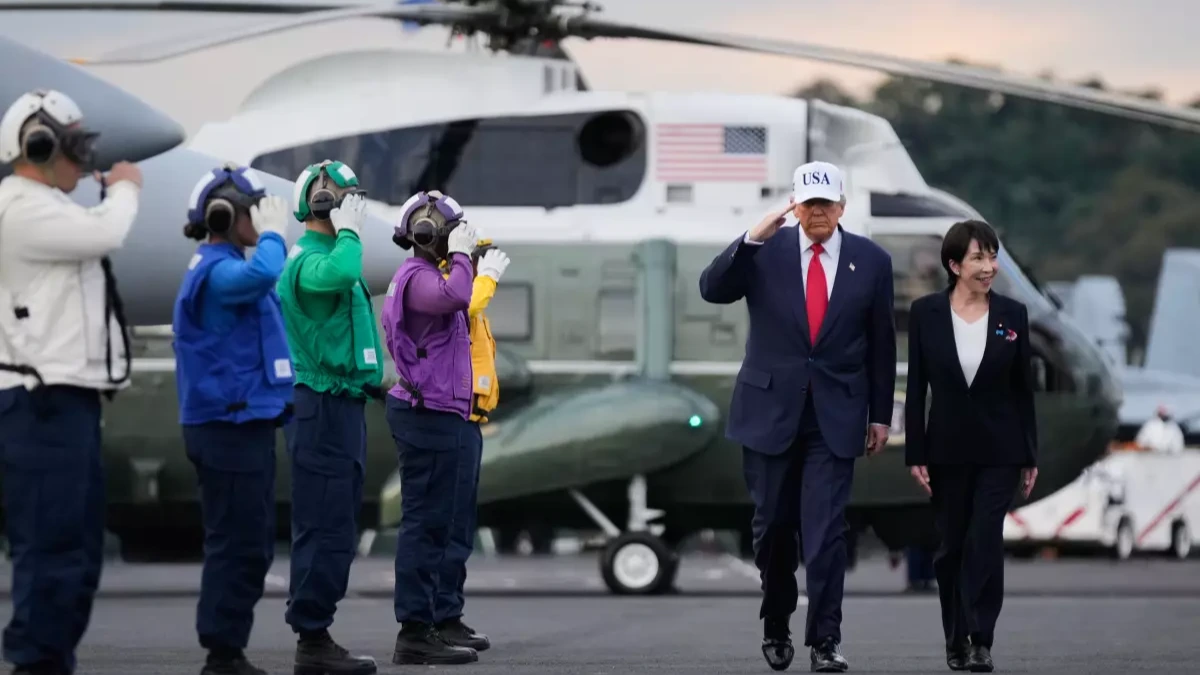
President Donald Trump’s latest moves to scale back U.S. military activity in the Pacific are raising concerns among American allies, particularly South Korea, as questions grow over Washington’s long-term commitment to regional security.
The unease follows Trump’s decision to significantly reduce joint military exercises with South Korea. The exercises, known as Ulchi Freedom Shield, are a central part of the two countries’ efforts to maintain military readiness and deter North Korea. South Korean officials said they were caught off guard by the decision, which was made without advance consultation.
The move comes as the United States is also repositioning military assets away from the region. The USS George Washington, described as the last U.S. aircraft carrier based in Asia, has departed the Pacific and is expected to head toward the Middle East. The redeployment has added to concerns that Washington may be placing greater emphasis on other global priorities.
South Korea Raises Concerns
For South Korea, the military exercises are more than routine training. They are viewed as an important component of the alliance’s deterrence strategy against North Korea.
The annual exercises allow U.S. and South Korean forces to practice command procedures and coordinate their responses to potential military threats. Defense analysts have warned that reducing field training could make it harder for troops and commanders to maintain operational familiarity.
Trump has defended the reduction, pointing to the cost of the exercises, South Korea’s position on U.S. efforts involving Iran and his relationship with North Korean leader Kim Jong Un. Trump has also argued that the drills can be provocative toward Pyongyang.
Allies Watching Closely
The uncertainty extends beyond the Korean Peninsula. Japan, Australia and other U.S. partners in the Indo-Pacific are closely watching Washington’s decisions as they assess what they mean for the broader regional security architecture.
The concern is not necessarily that the United States is abandoning its alliances, but that sudden policy changes could make allies less certain about how Washington would respond during a crisis.
Analysts have also pointed to the withdrawal of the aircraft carrier and the reduction in joint exercises as potentially mixed signals at a time when China is expanding its military capabilities and North Korea continues to develop its missile and nuclear programs.
Trump’s Outreach to North Korea
Trump’s decision comes alongside renewed speculation about diplomacy with North Korea. His administration has emphasized Trump’s personal relationship with Kim and the possibility of reopening direct talks.
Supporters of the approach argue that reducing military tensions could create an opportunity for negotiations. Critics, however, fear that weakening military readiness before securing meaningful concessions from Pyongyang could undermine deterrence.
North Korea has continued to criticize U.S.-South Korean military exercises as threats, while analysts remain skeptical that Pyongyang will readily abandon its nuclear capabilities.
A Test for U.S. Alliances
The latest developments highlight a broader challenge for the Trump administration: balancing its push for allies to assume more responsibility for their own defense with Washington’s traditional role as the central security provider in the Indo-Pacific.
South Korean officials have emphasized the importance of maintaining the alliance even as Seoul seeks greater responsibility for its own defense. Meanwhile, concerns about U.S. reliability could influence defense planning across the region.
For Washington’s allies, the key question is whether the latest changes represent a temporary adjustment in military strategy or a broader shift in America’s role in Asia.
As the Trump administration weighs its priorities across the Middle East, the Pacific and elsewhere, U.S. allies will be watching closely for clearer signals about the future of America’s security commitments.
Source: latimes