
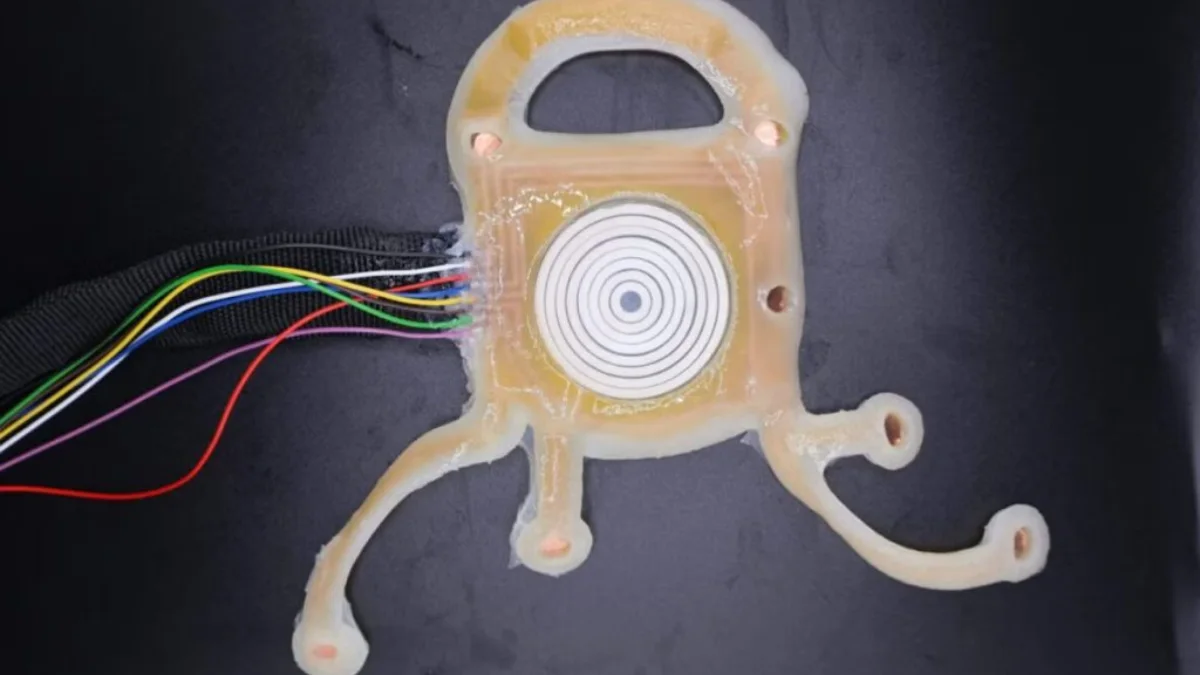
Sleep news : A new wearable device from researchers at the University of Texas at Austin could offer a different way to influence sleep. Called NEUSLeeP, the soft patch uses focused ultrasound and sensors to target a deep area of the brain linked to sleep and alertness.
In an early study involving 28 people, the device helped participants reach REM sleep about 43 minutes sooner on average. REM sleep also lasted around 16 minutes longer. Researchers say the results are promising, but much more testing is needed before the technology could become a product for everyday use.
How the Sleep Patch Works
NEUSLeeP is designed to work without surgery or implanted equipment. The patch sends focused ultrasound toward a small brain region called the subthalamic nucleus.
At the same time, built-in electrodes monitor brain activity. This creates a closed-loop system that can adjust the stimulation based on signals detected from the user.
The approach is different from traditional deep-brain stimulation, which requires implanted devices and surgery. Researchers are exploring whether ultrasound could provide a noninvasive way to reach deeper areas of the brain.
Early Study Shows Promising Results
Researchers tested the patch on 28 participants, including people with normal sleep and some who experienced sleep difficulties.
The study found that participants reached REM sleep an average of 43 minutes earlier. Their REM sleep also increased by about 16 minutes. Researchers also observed improved heart-rate variability among healthy participants.
Participants generally found the device comfortable and reported few adverse effects during the study. Brain imaging also showed changes in areas involved in emotional processing.
More Research Is Needed
Despite the encouraging results, experts and researchers caution that the study was small. A trial involving only 28 people cannot show whether the device will work safely and effectively for a much larger population.
Researchers plan to conduct larger studies to better understand the technology. Possible future applications could include conditions associated with disrupted REM sleep, such as chronic stress, depression and PTSD.
The technology is not currently available for consumers. There is no announced launch date or price, although a patent application has been filed and researchers are exploring possible commercialization.
For now, NEUSLeeP remains an experimental technology. The early findings suggest that wearable ultrasound could eventually become a new tool for studying and potentially influencing sleep, but larger clinical studies will be needed before its benefits and risks are fully understood.
To know more for Health news