
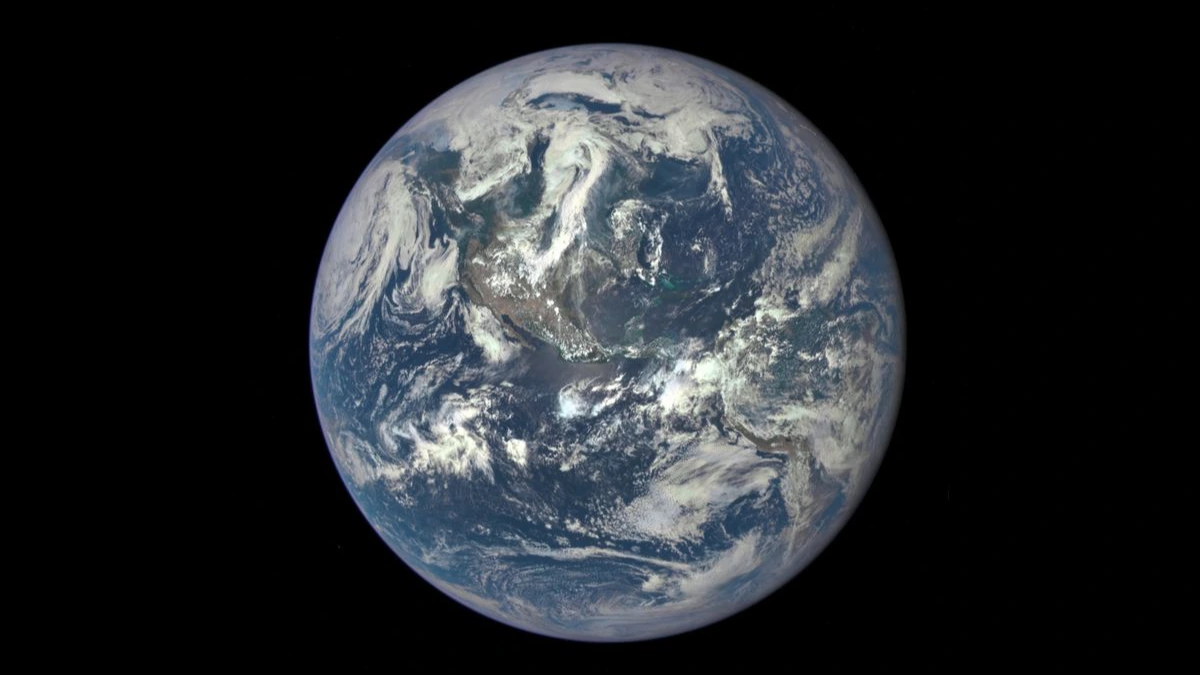
Solar system model: New computer simulations of planetary formation suggest that Earth’s emergence at its current distance from the Sun may be a natural outcome of the chaotic processes that shape young planetary systems, rather than an extraordinary cosmic accident.
For decades, scientists have relied on computer models to reconstruct how the planets in our Solar System formed. But many earlier simulations began with assumptions based on the Solar System as we see it today.
A new approach presented at the Origins 2026 conference in Paris takes a different path. Researchers led by planetary scientist Nader Haghighipour of the University of Hawaiʻi at Mānoa used randomized starting conditions and allowed the physics of planetary formation to determine the eventual architecture of the simulated systems.
Starting from scratch
The precise conditions that existed in the Solar System’s earliest protoplanetary disk remain unknown. Scientists do not know exactly how planetesimals and planetary embryos—the building blocks of planets—were distributed around the young Sun.
Haghighipour and his colleagues therefore ran more than 1,000 simulations using different distributions of these objects. Rather than forcing the simulations to reproduce the planets we already know, the researchers allowed planetary interactions to determine what emerged.
The results suggest that an Earth-like planet forming around one astronomical unit, the average distance between Earth and the Sun, can occur naturally during the evolution of a planetary system.
That finding is significant because it indicates that Earth’s location may not require an extraordinarily precise set of starting conditions.
Venus and Mars also emerge
The simulations produced other familiar features of our planetary neighborhood.
According to Haghighipour, Venus appeared in about 28% of the simulations and was able to maintain an orbit around its star. Depending on the particular model, it could end up inside the habitable zone or slightly beyond it.
Mars-like bodies also appeared near the region occupied by Mars today, although their sizes and orbital characteristics varied among simulations.
The findings highlight how dramatically planetary systems can change as they develop. Even relatively small differences in the initial arrangement of material can produce substantially different final planetary systems.
Faster simulations open new possibilities
Computational advances are also changing how researchers can investigate these questions.
Simulations that once required roughly six to eight months to complete can now be performed in about six to eight weeks on modern laptop computers, according to Haghighipour. That makes it possible for scientists to explore a much wider range of possible starting conditions.
Rather than asking a computer model to recreate the Solar System exactly, researchers can now investigate thousands of possible planetary histories and determine which characteristics naturally emerge.
What does this mean for life?
The research does not prove that life is common in the universe. The emergence of a planet with Earth’s general characteristics is only one step in a much longer chain of events leading to habitability and, potentially, life.
Still, the results could influence how scientists think about Earth-like worlds elsewhere.
Astronomers have discovered that planets roughly comparable in size to Earth, as well as somewhat larger super-Earths, can exist in the habitable zones of stars similar to the Sun. Understanding how naturally such worlds form could help researchers estimate how frequently potentially habitable environments arise.
Detecting life itself remains considerably more difficult. Current technology cannot simply determine whether a distant Earth-sized planet contains life, but studies of planetary formation can help scientists understand what physical conditions might make a world habitable.
Earth may not be a cosmic fluke
The central message from the new simulations is not that Earth is identical to every other planetary system. Instead, the research suggests that some of the characteristics that make our planet possible may arise naturally from the physics of planetary formation.
If Earth-sized worlds can emerge without researchers having to fine-tune the initial conditions, Earth’s existence may be less improbable than previously assumed.
As Haghighipour puts it, “There is no reason to believe that our Earth is a fluke.”
The next challenge for planetary scientists will be to determine how frequently these Earth-like outcomes occurand whether planets that form in similar ways can also develop the long term conditions necessary for life.
Source: universetoday