
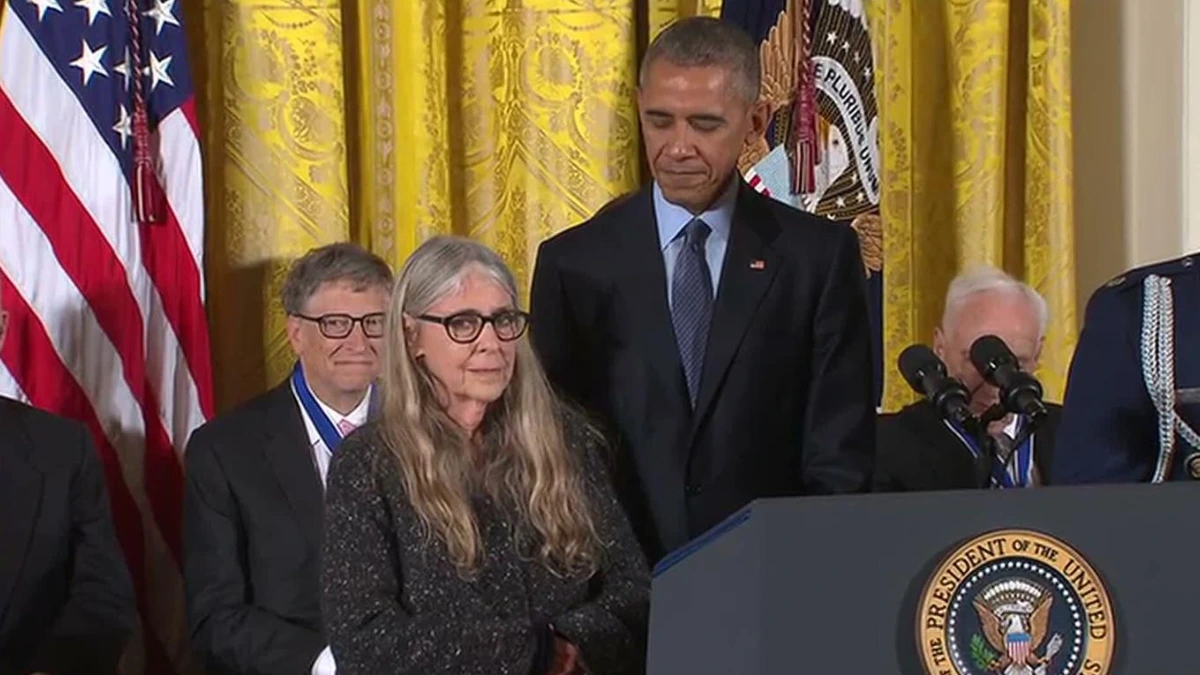
Margaret Hamilton, the pioneering computer scientist whose software played a crucial role in NASA’s historic Apollo 11 moon landing, has died at the age of 90.
The Massachusetts Institute of Technology announced that Hamilton died on September 30. Her work during the Apollo program helped establish software engineering as a recognized discipline and contributed to one of the most important achievements in the history of space exploration.
A Pioneer in Early Computing margaret hamilton
Hamilton began her programming career at MIT in the late 1950s, initially working on weather prediction systems. She later joined MIT Lincoln Laboratory, where she developed software for the U.S. Air Force’s SAGE air-defense system.
In 1965, she joined MIT’s Instrumentation Laboratory after it received a NASA contract to develop the onboard flight software for the Apollo missions. Hamilton became the project’s first programmer and eventually led teams responsible for software used during crewed Apollo flights.
At a time when software development was still a relatively new field, Hamilton championed careful programming designed to anticipate errors and keep critical systems functioning under unexpected conditions.
Her Software Helped Save Apollo 11
Hamilton’s most famous contribution came during the Apollo 11 mission in July 1969.
Just before the lunar module was scheduled to land on the Moon, the spacecraft’s computer began displaying alarms. The warnings indicated that the computer was overloaded, creating the possibility that the landing might have to be aborted.
However, the software created by Hamilton and her team had been designed to prioritize the most important tasks. It was able to identify the problem, discard lower-priority activities and continue processing the functions essential to the landing.
The Apollo 11 landing proceeded successfully, allowing Neil Armstrong and Buzz Aldrin to become the first humans to walk on the Moon.
The episode later became one of the defining examples of Hamilton’s approach to reliable and fault-tolerant software.
A Lasting Legacy margaret hamilton
Hamilton continued working in computing after the Apollo program, eventually founding software companies and developing approaches focused on reliability, error prevention and complex systems engineering.
Her contributions received numerous honors. In 2016, President Barack Obama awarded her the Presidential Medal of Freedom, the nation’s highest civilian honor. She was also recognized by NASA and several organizations for her contributions to computer science and aerospace engineering.
Hamilton later became an important figure for women entering science, technology and engineering. A widely circulated photograph of her standing beside stacks of Apollo software code became an enduring image of the early history of software engineering.
Her influence extended well beyond the Apollo missions. She helped establish the idea that software deserved the same engineering discipline and attention to reliability as hardware.
Hamilton is survived by her daughter, son-in-law, two grandsons and four great-grandchildren. A memorial service is expected to be held in Cambridge, Massachusetts, in the spring.
Margaret Hamilton’s legacy remains closely tied to the Apollo 11 achievement, but her impact reaches much further. Her pioneering work helped shape modern software engineering and demonstrated how carefully designed code could become essential to the success and safety of complex missions.