
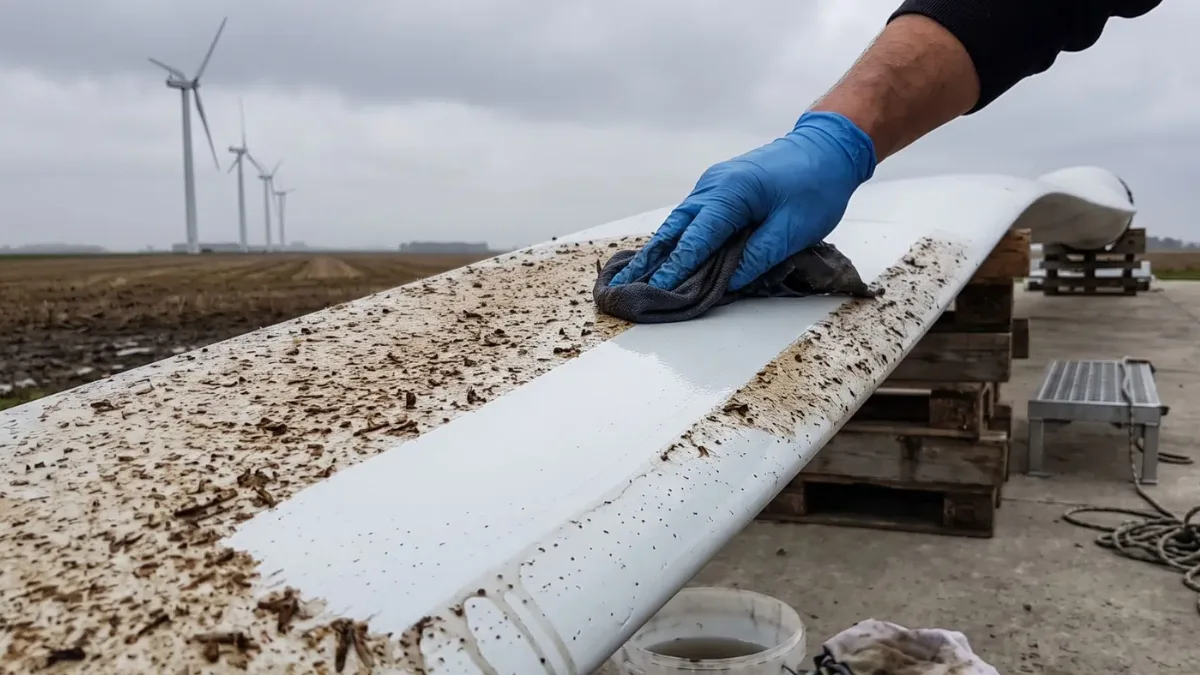
Wind turbines may face an unexpected threat that can reduce their performance: insects. Advances in turbine blade technology have improved efficiency, but insect remains can still collect along the leading edge and create a rough surface that interferes with the airflow needed to generate electricity efficiently. According to a recent Ecoportal report, seasonal production losses from this buildup can reach up to 25% in some circumstances.
The problem can be difficult to identify because the buildup often happens when winds are calm. During those periods, turbines may continue operating normally, meaning the loss is not immediately obvious. When stronger winds arrive later, however, the rough blade surface can cause airflow to separate earlier, reducing aerodynamic efficiency and lowering power production.
Why Turbine Blades Collect Insect Remains
The leading edge of a turbine blade is the first part to meet the moving air. Because of its shape and position, it can collect insects as the blades rotate. The source report explains that insects can fly during periods of light wind, when turbine blades may still be turning slowly.
As insects hit the blade, residue can remain attached to the surface. Over time, this creates a rough coating that changes the aerodynamic properties of the blade. Once wind speeds increase, the rough surface can interfere with smooth airflow across the blade and reduce the lift needed to produce power.
The issue is particularly interesting because standard mechanical inspections may not identify it as a mechanical failure. The gearbox, pitch system and other major components can continue working properly while the blade surface quietly reduces the turbine’s efficiency.
The Potential Energy Loss Is Significant
Research discussed in the report indicates that the effect can become substantial at higher wind speeds. Under some conditions, a heavily contaminated turbine can experience a major reduction in power output, while seasonal production losses have been estimated at up to 25%.
The issue is not limited to electricity production. The large number of insects hitting turbines also raises questions about the environmental impact of wind farms. One assessment cited by the report estimated that insects killed at German wind turbines could amount to roughly 1,300 tons during a growing season, although such estimates depend on several assumptions.
Cleaning and New Coatings Could Help
One of the simplest solutions is also one of the most difficult to carry out: cleaning the blades. Turbine blades can be hundreds of feet above the ground, requiring specialized equipment and trained crews to safely reach their leading edges.
Researchers and turbine operators are also exploring coatings designed to make it harder for insect residue to stick to blade surfaces. According to the report, early testing of some coatings has shown promise, although more work is needed to determine how well they perform over long periods and during heavy insect seasons.
As wind energy becomes an increasingly important source of electricity, keeping turbines operating efficiently will become even more important. A problem as small as insect residue may seem insignificant, but when it covers thousands of large turbine blades, the effect can become a meaningful challenge for wind farm operators.
Source : ecoportal