
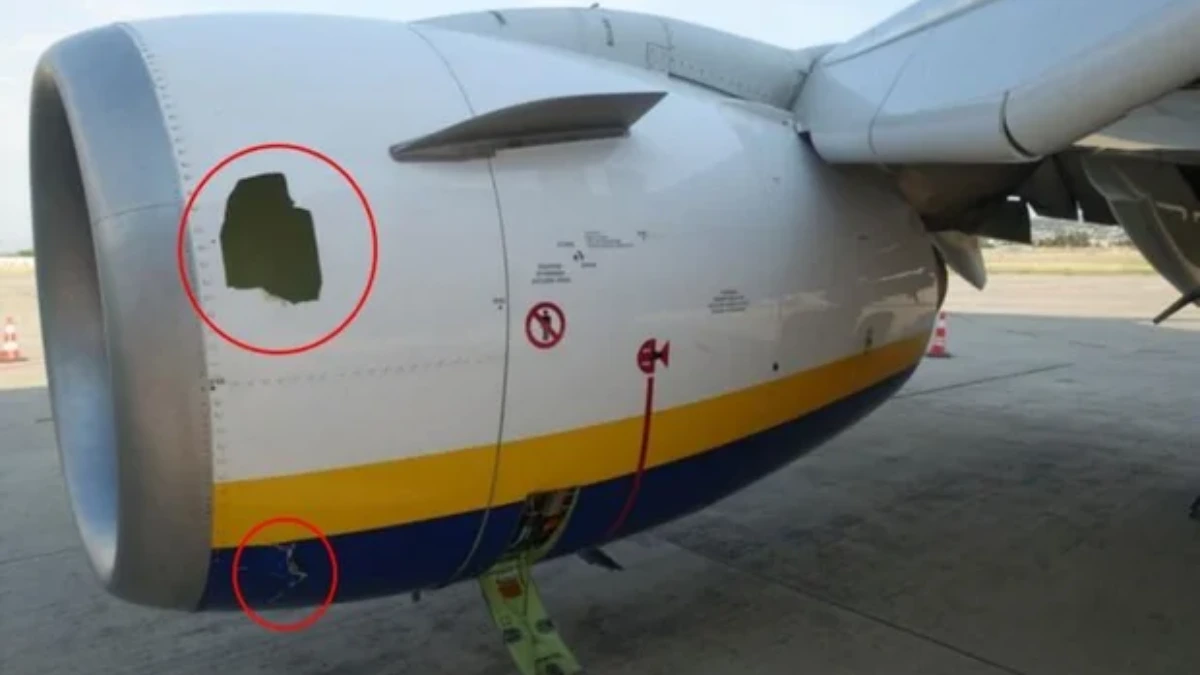
Investigators have found bird remains inside the engine of a Ryanair Boeing 737, raising new questions about Boeing 737 Ryanair engine damage after the aircraft suffered a dramatic engine failure shortly after takeoff last month. The incident caused debris to shatter a cabin window, leaving a passenger partially sucked through the opening.
The U.S. National Transportation Safety Board said in a preliminary report that the discovery raises the possibility that a bird strike contributed to the July 10 incident, although investigators have not yet established whether the remains came from that particular flight.
Engine Failure Shattered Passenger Window
Ryanair Flight 1879 was traveling from Thessaloniki, Greece, to Memmingen, Germany, when its No. 2 engine failed just minutes after takeoff.
According to the NTSB, one of the engine’s fan blades broke apart, sending fragments through the engine casing. The debris struck the aircraft’s fuselage at several locations and ultimately shattered a passenger window in row 11.
The cabin rapidly depressurized, and the passenger seated at 11F was partially pulled through the damaged window. The 61-year-old Serbian man suffered serious injuries but survived.
Other passengers managed to pull him back inside the aircraft. A doctor traveling on the flight then provided medical assistance while the aircraft returned to Thessaloniki International Airport.
Bird Evidence Found Inside Engine
NTSB investigators discovered feathers and other bird remains deep inside the failed engine.
The finding is significant because the aircraft had experienced four reported bird strikes during the previous 12 months. Bird remains had also been recovered in two of those earlier incidents.
However, investigators caution that the remains discovered after the July 10 event may not necessarily be connected to the engine failure. Because they were found deep inside the engine, investigators said they could have originated from an earlier bird strike.
Samples have been sent to the Smithsonian Institution Feather Identification Lab in Washington, D.C., for further examination.
Signs of Metal Fatigue Also Found
The preliminary investigation has uncovered another possible factor.
Investigators found evidence of metal fatigue near the base of the fan blade that broke away. Three loose fan-blade fragments were recovered from the engine.
The NTSB also found that vibrations in the No. 2 engine were higher than those recorded in the No. 1 engine during the final portion of takeoff.
The findings mean investigators are examining multiple possible contributors rather than attributing the incident solely to a bird strike.
Passenger Describes Terrifying Moment
The passenger who was nearly pulled from the aircraft later described the frightening experience.
He told The Guardian that he remembers little from the incident and continued to experience head and neck pain afterward. He credited his survival in part to being restrained by his seat belt.
A flight attendant told investigators that, after the cabin lost pressure and oxygen masks deployed, crew members saw the passenger partially lodged in the damaged window.
Passengers then helped bring him back into the cabin and moved him to another row for treatment.
Plane Returned Safely
There were 149 passengers and six crew members aboard Flight 1879. The aircraft immediately returned to Thessaloniki after the emergency, and no other passengers or crew members were injured.
Investigators also noted that certain engine updates required for U.S. airlines had not been performed on the aircraft. Because Ryanair is an Irish airline, however, it is not subject to those specific Federal Aviation Administration requirements.
Boeing said it continues to support the NTSB investigation and is working with Ryanair and Malta Air.
Investigation Continues
Boeing 737 ryanair engine damage: The NTSB has not yet reached a final conclusion about what caused the engine failure or the resulting damage to the aircraft.
The bird remains will undergo laboratory examination, while investigators continue analyzing the engine, fan-blade damage, flight-data recordings and other evidence.
The NTSB said a final report is expected to take 12 to 24 months.
For now, the investigation points to a potentially complex chain of events: a failed engine, a broken fan blade, debris penetrating the fuselage and a shattered window that nearly ejected a passenger from the aircraft.
Whether a bird strike triggered that chain or whether the bird remains were unrelated remains one of the key questions investigators must answer.
Source: cbsnews