
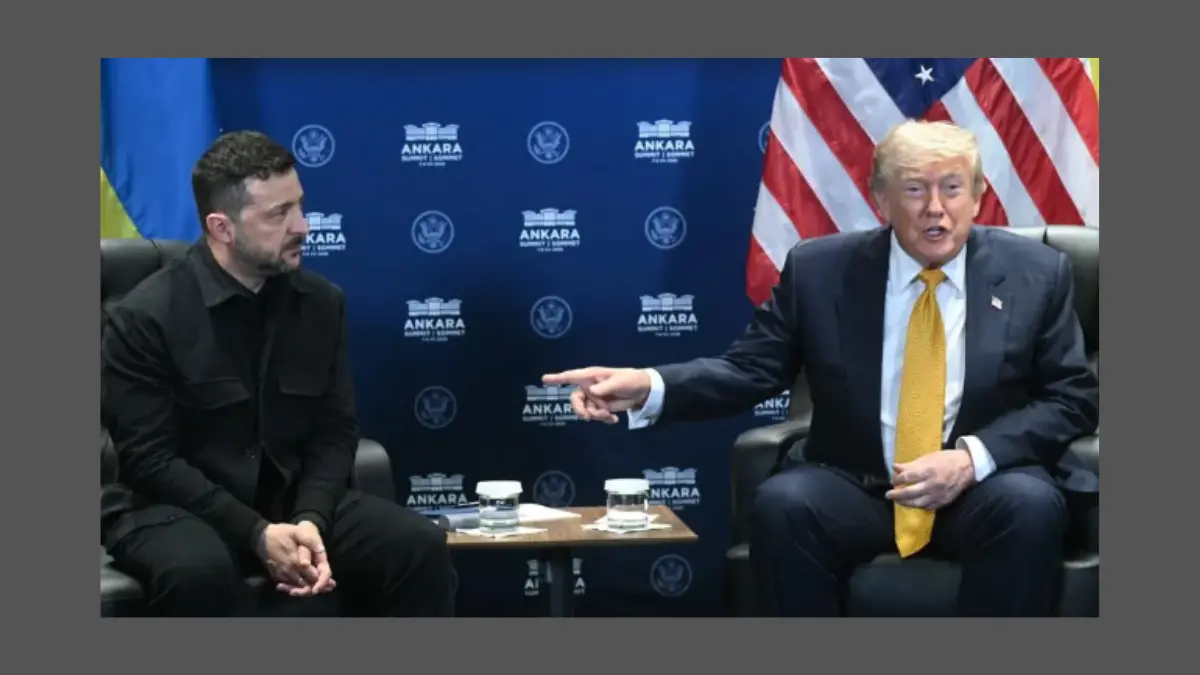
President Donald Trump sparked widespread discussion after mistakenly referring to Japan as the “Islamic Republic of Japan” while speaking about a past missile threat involving the USS Abraham Lincoln. The comment came during a press conference alongside Ukrainian President Volodymyr Zelenskyy at the NATO summit in Ankara, Turkey. While describing the aircraft carrier as one of the largest and most powerful in the world, Trump claimed that “111 missiles” had been fired at the vessel “a few months ago” by the “Islamic Republic of Japan,” adding that all of the missiles were intercepted. The unusual remark quickly spread across social media and became one of the most talked-about moments from the event.
The incident Trump appeared to reference is widely associated with heightened military tensions involving Iran rather than Japan. Earlier this year, the USS Abraham Lincoln was deployed in the Arabian Sea, where U.S. forces reported intercepting a drone that approached the carrier during a period of escalating regional conflict. Iran later claimed that it had struck the aircraft carrier with ballistic missiles, but U.S. Central Command firmly denied the allegation, stating that the USS Abraham Lincoln was never hit and that the missiles did not come close to the ship. The U.S. military said the carrier continued normal flight operations and remained fully operational throughout the mission.
Trump’s mention of Japan drew immediate attention because the country has been one of the United States’ closest allies for more than seven decades. The two nations have maintained a strong security partnership since the early 1950s under a mutual defense treaty, with around 60,000 American troops stationed across Japan. As a result, many observers viewed the president’s wording as an apparent verbal slip rather than a reference to any actual military confrontation involving Japan.
Although the White House did not immediately clarify the statement, the phrase “Islamic Republic of Japan” quickly went viral, generating reactions from journalists, political analysts, and social media users around the world. The comment overshadowed much of the broader discussion at the NATO summit, highlighting how a single unexpected remark can dominate news coverage and online conversations within minutes.