
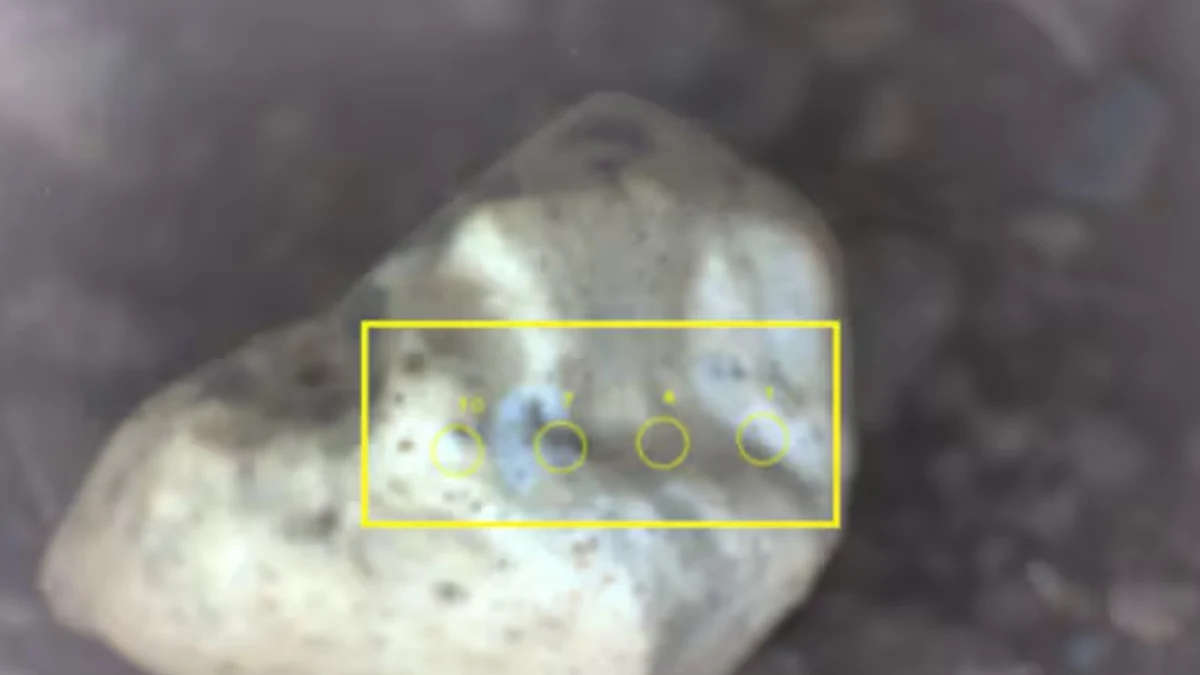
NASA’s Perseverance rover has made an unexpected discovery while exploring the Mars Planet and its Jezero Crater. After firing its laser at several rocks, the rover detected unusually high concentrations of minerals associated with gemstones, giving scientists fresh clues about the Red Planet’s geological history.
Laser Analysis Reveals Unusual Minerals
The discovery came through Perseverance’s SuperCam instrument, which uses a laser to study the chemical composition of rocks from a distance. Researchers found clear signatures of chromium-bearing corundum in three plagioclase-rich rocks near the crater rim. Corundum is a mineral associated with gemstones such as ruby and sapphire on Earth, although the Martian material is not necessarily gem-quality.
Scientists described the result as unexpected because these minerals were found in an area where they were not anticipated. The finding suggests that the rocks may have undergone geological changes involving heat, fluids and chemical reactions over Mars’ long history.
Ancient Water May Hold the Key
Researchers believe hot water could have moved through cracks in the Martian rocks millions or even billions of years ago. On Earth, water interacting with rocks under particular temperature and chemical conditions can help form or alter minerals and crystals. The discovery therefore provides another clue that water once played an important role in shaping parts of Mars.
The finding could also help scientists reconstruct the ancient environment of Jezero Crater. Perseverance is exploring the region because it once contained a lake and river delta, making it an important location for investigating whether Mars had environments that could have supported microbial life in the distant past.
What the Discovery Means for Mars Exploration
The mineral discovery does not prove that life ever existed on Mars, but it adds to scientists’ understanding of the planet’s complex geological history. The minerals could provide information about ancient water movement, volcanic processes and the conditions beneath the Martian surface.
Perseverance continues to examine rocks and collect samples that could eventually be returned to Earth for more detailed laboratory analysis. Scientists hope those samples will provide a clearer picture of how Mars changed from a potentially wetter world into the cold, dry planet seen today.
The latest discovery demonstrates why seemingly ordinary Martian rocks remain valuable targets for exploration. With each laser analysis and sample, NASA’s rover is helping researchers uncover new details about the Red Planet’s past.
Source : ndtv