
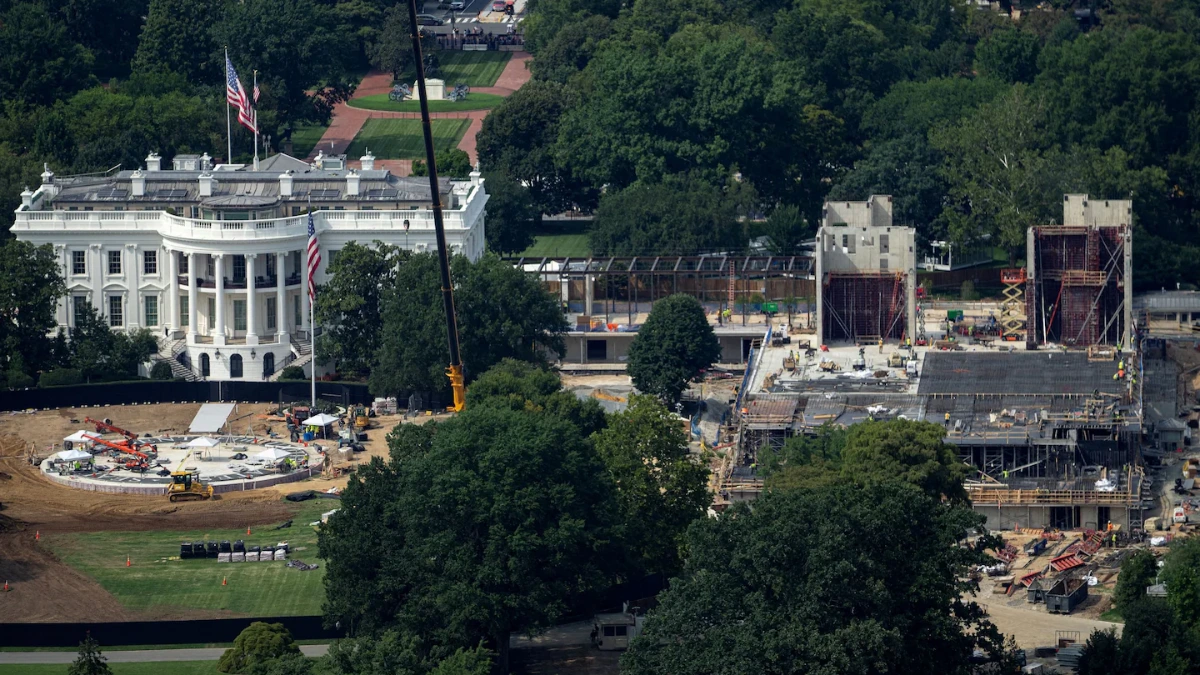
President Donald Trump is recasting his controversial White House ballroom project as a national-security necessity as his administration fights a court order that has halted above-ground construction.
The project was initially presented as a way to create a larger, more suitable venue for state dinners and other high-profile White House events. But in recent legal filings and public statements, the administration has increasingly emphasized the security features of the planned structure, describing it as part of an integrated military complex.
The change in emphasis comes as Trump faces a growing legal challenge over whether his administration had the authority to proceed with the project without explicit congressional approval. A federal appeals court ruled Aug. 7 that construction of the roughly $400 million ballroom could not continue above ground without authorization from Congress.
The Trump administration has appealed the dispute to the Supreme Court. In its emergency request, Solicitor General D. John Sauer argued that stopping construction would interfere with a project that includes important national-security infrastructure. The administration has pointed to security concerns involving the president and Air Force One in making its case for allowing construction to proceed.
Trump’s description of the project represents a notable evolution from his original pitch. The ballroom was initially promoted primarily as an elegant new space for large White House gatherings. The administration now argues that the broader facility would provide secure areas and other infrastructure intended to protect the president and other officials.
The legal dispute has also raised questions about the limits of presidential authority over the White House complex. Preservation groups and other challengers argue that major changes to the historic property require congressional involvement, while the administration maintains that the president has broad authority over White House facilities and that the project’s security implications justify continued work.
The court battle has placed construction on a tighter timetable. The administration says the project is already substantially underway and has urged the Supreme Court to allow construction to continue while the broader appeal is considered.
The National Trust for Historic Preservation has been among the groups challenging the project. The dispute centers not only on the ballroom itself but also on the administration’s decision to demolish the existing East Wing and replace it with a substantially larger structure.
For Trump, the ballroom has become both a signature White House renovation and a test of presidential power. By framing the project as a national-security and military facility rather than simply an event space, the administration is seeking to strengthen its argument that construction should not be delayed by the courts.
The Supreme Court’s response could determine whether Trump can continue building the project while the underlying legal questions are resolved. Until then, the planned ballroom remains at the center of an unusual clash between presidential ambitions, historic preservation and the separation of powers.
Source: washingtonpost