
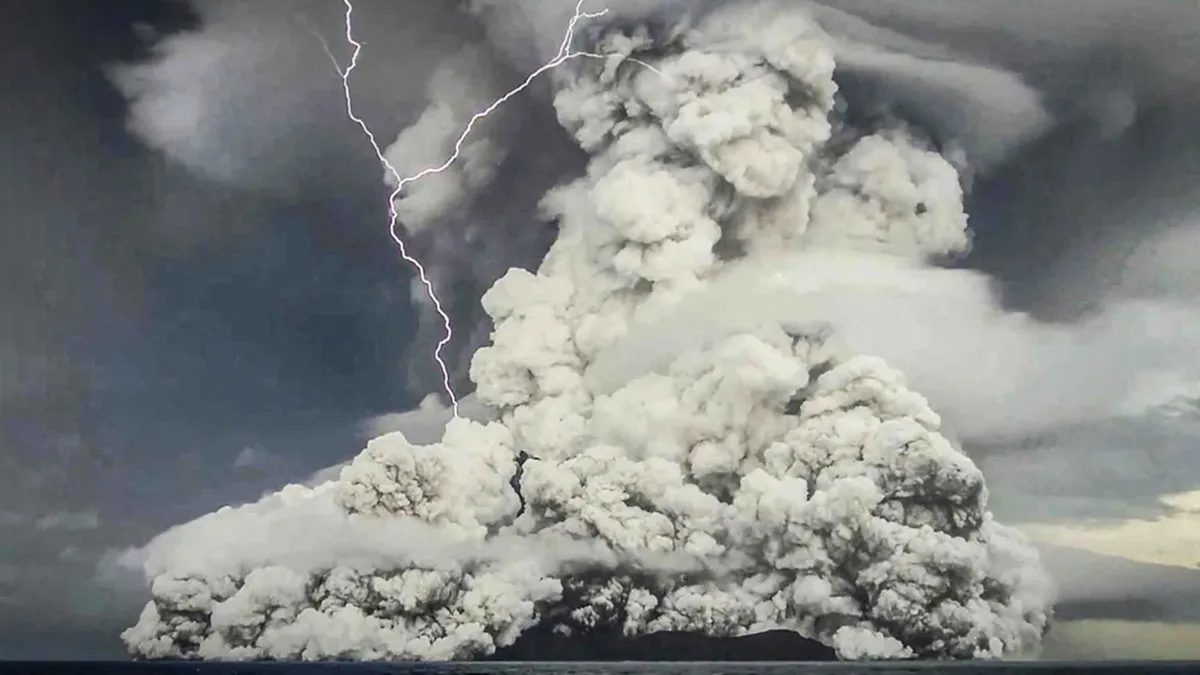
Scientists are investigating an unexpected chemical process involving a volcano that may have helped destroy methane after the 2022 Hunga Tonga-Hunga Ha’apai eruption. The volcano clouds methane connection was identified through satellite observations showing unusually high levels of formaldehyde, a chemical produced when methane breaks down in the atmosphere.
Satellite Data Reveals Surprising Chemistry
Researchers studied the enormous volcanic plume created by the underwater eruption in the South Pacific. The cloud contained record-high concentrations of formaldehyde, which provided evidence that methane was being broken down inside the plume.
Scientists tracked the chemical signal for about 10 days, from the eruption area toward South America. Because formaldehyde remains in the atmosphere for only a short period, researchers said its continued presence suggested that methane destruction was taking place throughout the plume.
The study was published in Nature Communications and involved researchers from institutions including the University of Copenhagen, the Royal Belgian Institute for Space Aeronomy and the Royal Netherlands Meteorological Institute.
How Volcano Clouds May Destroy Methane
Researchers believe the process involved a combination of volcanic ash, seawater and sunlight. Hunga Tonga erupted beneath the ocean, sending large amounts of seawater and volcanic material high into the atmosphere.
According to the researchers, sunlight interacting with salty material and volcanic particles may have produced highly reactive chlorine atoms. These chlorine atoms can react with methane molecules, helping break the greenhouse gas apart.
The researchers estimated that the eruption released about 300 gigagrams of methane. At the same time, they calculated that the volcanic plume removed roughly 900 megagrams of methane per day during the observed process.
Possible Impact on Climate Research
Methane is an important greenhouse gas, and its relatively short atmospheric lifetime means that reducing methane can influence warming on a shorter timescale than reducing carbon dioxide alone.
The discovery could also affect how scientists calculate the global methane budget. Researchers say atmospheric dust and volcanic material may play a larger role in methane removal than previously recognized.
Scientists are also exploring whether understanding this natural process could eventually contribute to research into atmospheric methane removal. However, any attempt to reproduce such chemistry would require extensive research to determine its safety and environmental effects.
The findings demonstrate how satellite observations can reveal chemical processes occurring far above Earth’s surface and provide new information about how volcanic eruptions interact with the atmosphere.
Source : sciencedaily.com