
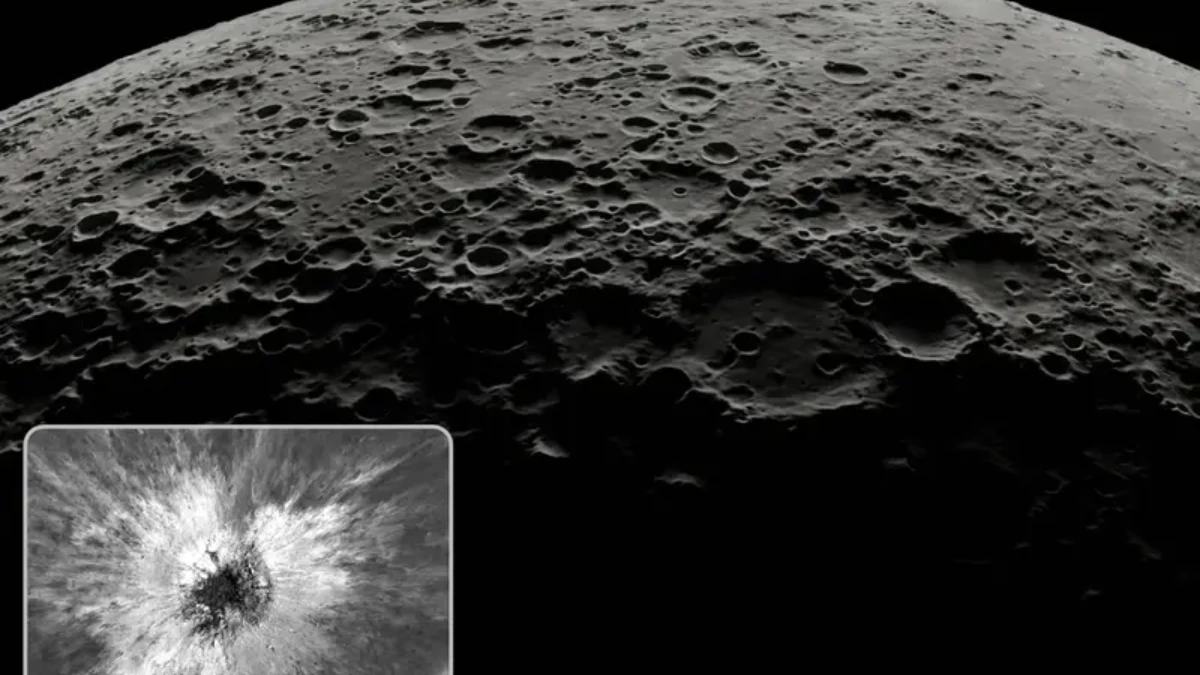
Asteroid impact: NASA’s Lunar Reconnaissance Orbiter has helped scientists identify a newly formed crater on the Moon, created by a powerful impact estimated to occur only about once a century.
A routine review of lunar images has led to the discovery of a remarkably fresh crater on the Moon, giving scientists an unusual opportunity to study the immediate effects of a space-rock impact on the lunar surface.
Researchers working with data from NASA’s Lunar Reconnaissance Orbiter (LRO) identified the new feature by comparing images of the same area taken at different times. The discovery was reported in September 2026 and provides scientists with a detailed look at how a relatively large impact changes the Moon’s surface.
A Crater Created by a Powerful Impact
The newly identified crater has been officially named McGetchin crater, honoring pioneering lunar scientist Tom McGetchin.
According to NASA, the crater formed on the eastern edge of the Moon sometime between April 11 and May 22, 2024. Scientists believe a comet or asteroid roughly comparable in size to a three- to six-story building struck the lunar surface and produced the feature.
The resulting crater measures approximately 728 feet (222 meters) across and reaches about 141 feet (43 meters) deep. Its width is roughly equivalent to two football fields.
Scientists estimate that an impact capable of producing a crater of this size happens on the Moon approximately once every century or even less frequently, making the discovery particularly valuable for lunar research.
How NASA Found the New Moon Crater
The discovery began during what was essentially a routine data-quality check.
Robert Wagner, an image-processing specialist associated with the Lunar Reconnaissance Orbiter Camera system, was examining a large lunar map when he noticed an unusual bright feature surrounded by a darker area.
That pattern suggested that lunar material had recently been disturbed.
Scientists can identify fresh impacts by comparing images collected before and after an event. An impact can excavate material from below the surface and scatter it around the newly created crater. In images, this material can appear as a bright pattern against the surrounding terrain.
Wagner used image-processing software to compare hundreds of observations. Features that had remained unchanged appeared differently from areas where the lunar surface had changed.
The unusually large debris pattern surrounding McGetchin crater made it stand out from many of the smaller changes normally detected in LRO data.
NASA’s Lunar Reconnaissance Orbiter Played a Key Role
NASA’s Lunar Reconnaissance Orbiter has been studying the Moon for more than 17 years.
The spacecraft travels around the Moon and uses multiple scientific instruments to examine its topography, composition, temperature, and radiation environment. Its observations have allowed scientists to monitor changes across the lunar surface over long periods.
The Lunar Reconnaissance Orbiter Camera (LROC) is particularly important for identifying surface changes. Its Wide-Angle Camera can produce broad maps, while its Narrow-Angle Cameras provide much more detailed views.
After the new crater was identified in wide-area observations, researchers examined it with the higher-resolution Narrow-Angle Camera. Those follow-up images helped scientists determine the crater’s size, shape, and surrounding debris pattern.
The Moon Is Still Being Hit by Space Rocks
The discovery also demonstrates that the Moon is not a completely static world.
Unlike Earth, the Moon has essentially no substantial atmosphere to burn up incoming meteoroids before they reach the ground. As a result, objects traveling through space can strike the lunar surface directly.
Most impacts are far smaller than the event that created McGetchin crater. NASA says LRO scientists have identified at least 1,000 new impact craters during the spacecraft’s mission, along with roughly 100,000 other surface changes associated with impacts and their ejecta.
Some of the smallest detectable craters are only around 30 feet across. NASA estimates that impacts producing craters of that approximate scale may create around 140 new craters across the Moon each year.
However, many impacts involve objects so small that their resulting marks cannot be distinguished in orbital imagery.
A Large Cold Spot Surrounds the Crater
McGetchin crater provided another scientific surprise when researchers examined it using temperature measurements from LRO’s Diviner instrument.
Scientists found that an area extending roughly four miles around the crater was cooler at night than the surrounding surface. The difference was approximately 16 degrees Fahrenheit.
Researchers attribute the cooling to changes in the lunar soil, known as regolith.
When a large object strikes the Moon, it excavates and redistributes surface material. The impact can make the regolith less compact, changing its ability to retain heat after sunset.
The discovery is significant because it indicates that the effects of an impact can extend far beyond the visible crater itself.
Why Fresh Lunar Craters Matter
Fresh impact craters are particularly useful to planetary scientists because they provide a natural laboratory.
Scientists can study a newly formed crater and compare it with older lunar features to understand how impacts alter the Moon’s surface over time. Because the Moon lacks wind, rain, flowing water, and other strong erosion processes found on Earth, many impact features remain preserved for extremely long periods.
Observing a crater soon after it forms gives researchers an opportunity that is rarely available: studying the immediate consequences of an impact rather than trying to reconstruct them millions or billions of years later.
The McGetchin crater discovery also provides information about how impact debris spreads and how the lunar surface responds thermally after a collision.
What the Discovery Could Mean for Future Lunar Exploration
Understanding how impacts modify lunar soil could become increasingly important as spacecraft, robotic landers, and eventually astronauts operate on the Moon.
Changes to the regolith can affect how equipment interacts with the surface. NASA notes that the physical changes surrounding an impact could influence how rover wheels move across the terrain.
This type of information may therefore be useful not only for planetary science but also for understanding the changing lunar environment as exploration expands.
NASA and other space agencies are planning increasingly ambitious lunar missions, making detailed knowledge of the Moon’s surface conditions an important part of future exploration.
A Rare Snapshot of the Moon Changing
The discovery of McGetchin crater highlights the scientific value of repeatedly observing the same planetary surface.
The Moon may appear unchanged when viewed from Earth, but spacecraft observations reveal a world that continues to experience impacts and other physical changes.
In this case, NASA’s long-running Lunar Reconnaissance Orbiter mission allowed scientists to compare observations from before and after the impact. That made it possible to identify a crater that formed only recently on geological timescales.
For researchers, the event is more than the discovery of another crater. It is a rare opportunity to examine the effects of a relatively large lunar impact while the evidence remains fresh.
As LRO continues monitoring the Moon, its observations are expected to provide further insight into how impacts reshape the lunar landscape and what those changes could mean for future exploration.
Key Facts at a Glance
- Crater: McGetchin crater
- Location: Eastern edge of the Moon
- Formation window: April 11–May 22, 2024
- Width: About 728 feet (222 meters)
- Depth: About 141 feet (43 meters)
- Likely impactor: A comet or asteroid roughly three to six stories in size
- Estimated frequency: Approximately once per century or longer
- NASA mission: Lunar Reconnaissance Orbiter
- Additional observation: A roughly four-mile-wide area around the crater was found to be significantly cooler at night
NASA published its report on the discovery on September 16, 2026.
Source: science.nasa.gov