
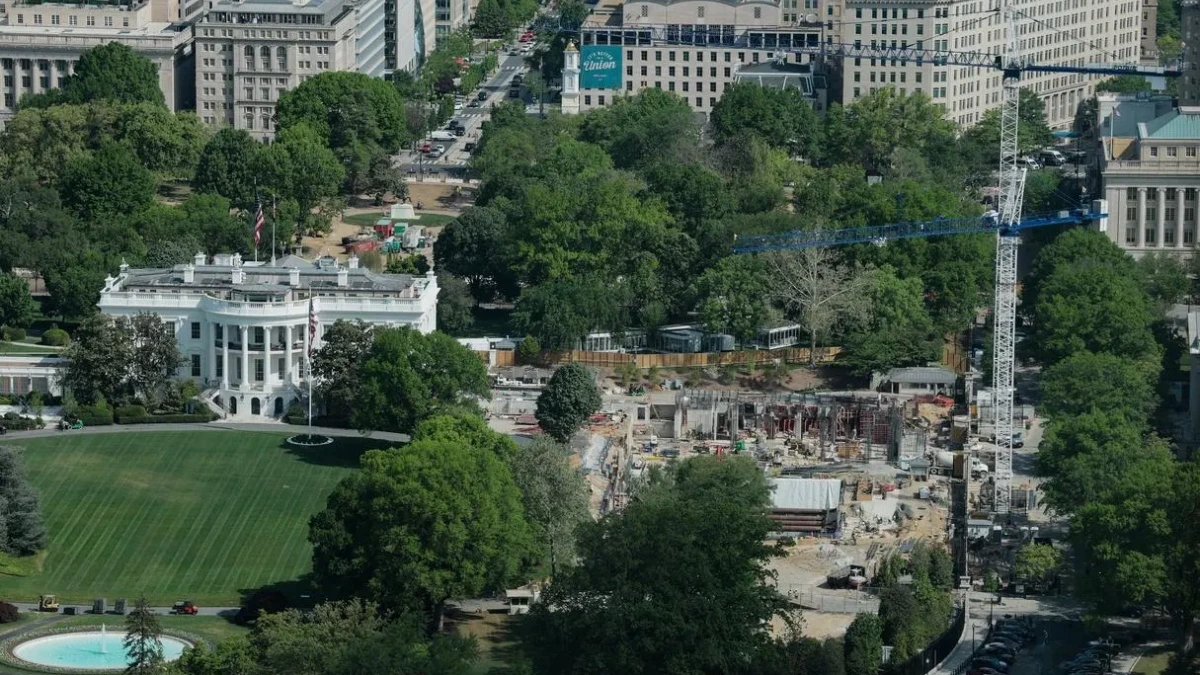
Bunker: A previously undisclosed hardened facility beneath the White House complex is raising new questions about the Trump administration’s national-security justification for constructing a massive new ballroom and underground military complex.
According to three former federal officials cited by The Washington Post, the presidential complex already contains a highly protected underground bunker capable of sheltering the president and senior aides during a major national-security emergency. The facility was secretly completed during the Obama administration and is located more than 60 feet below the White House complex.
The revelation could complicate the administration’s legal argument in its ongoing battle over President Donald Trump’s proposed $600 million ballroom complex. Trump officials have argued before the Supreme Court that the project is essential to protecting the president and ensuring continuity of government during a crisis.
Existing Bunker Raises Questions
Former officials told the Post that the existing facility was specifically designed to protect the president and senior government officials from severe threats, including a nuclear attack. It can reportedly accommodate dozens of people for multiple weeks.
That description closely overlaps with some of the security functions the Trump administration has cited in defending the new project.
Trump officials have described the underground portion of the planned complex as essential to maintaining presidential command and control during an attack. Army Secretary Dan Driscoll told the Supreme Court in an August filing that the new facility was necessary to allow the president to continue operating during a crisis.
Former officials, however, questioned why a new hardened facility is necessary if the White House already possesses one designed for precisely such emergencies.
The Washington Post said it is withholding some details about the existing bunker because of concerns that revealing them could compromise White House security protocols.
Trump Administration Defends Ballroom
The White House has rejected the suggestion that the existing bunker eliminates the need for the new construction.
White House spokesman Davis Ingle said the East Wing modernization project is closely connected to the security of the president, the White House grounds and other security infrastructure. He also pointed to threats involving drones and large-scale events as reasons for the project.
Trump has increasingly described the planned ballroom project as having a military and national-security role. He has argued that the facility would include protections against drones and other threats and has publicly referred to the project as a “military complex.”
Administration officials have also argued that the ballroom and underground military facility are closely connected and that stopping one could undermine the other.
Supreme Court Battle Continues
The dispute over the project has moved through the federal courts.
A district judge and a federal appeals panel previously ordered the administration to stop construction until Congress authorizes the project. The courts nevertheless allowed certain national-security-related work to continue.
On Friday, Chief Justice John Roberts issued an order allowing the Trump administration to continue construction temporarily while the Supreme Court considers an emergency appeal.
The administration has been racing to advance construction. Officials told the Supreme Court earlier this month that the project was approximately 65% complete, with hundreds of workers involved in around-the-clock construction efforts.
Security Claims Under Scrutiny
The existence of the older bunker adds another layer to the legal and political dispute.
The administration has argued that modern threats including increasingly sophisticated commercial and military-grade drones have created an urgent need for additional security infrastructure. Officials say the new complex would provide reinforced spaces capable of protecting the president and maintaining government operations during an attack.
But former officials cited by the Post say the existing underground facility already provides many of those capabilities.
They also raised concerns that demolishing the East Wing and exposing previously concealed areas could itself create security vulnerabilities. The older Presidential Emergency Operations Center, or PEOC, was located much closer to the surface and may have been affected by the construction, according to the former officials.
A High-Stakes Legal Fight
The ballroom dispute is ultimately about more than architecture. It raises questions about presidential authority, congressional oversight and the extent to which national-security concerns can be used to justify construction on the historic White House grounds.
The National Trust for Historic Preservation has challenged the project, arguing that Trump does not have the authority to make wholesale changes to the White House grounds without congressional approval. The organization has said it was not briefed about the secret bunker or asked by the White House to avoid litigation on national-security grounds.
As the Supreme Court considers the administration’s appeal, the newly detailed existence of the hardened underground facility could become an important point of contention.
For the Trump administration, the central question is whether the planned complex provides security capabilities that the existing bunker cannot. For opponents, the facility raises a different question: if the White House already has a hardened command center, how essential is the new ballroom complex to national security?
The answer could influence both the legal battle over the project and the future of one of the most consequential renovations in the history of the White House.
Source: washingtonpost